

RAG for reliable AI: How to Boost LLM Response Accuracy and Reduce Hallucination
TL;DR
- Retrieval-augmented technology (RAG) is an AI structure that enhances LLM accuracy by dynamically retrieving related, up-to-date info from exterior information sources
- RAG considerably reduces hallucinations and improves response accuracy in vital domains like healthcare (96% diagnostic accuracy) and authorized (38-115% productiveness positive factors)
- RAG implementation requires strategic setup, reminiscent of a curated information base or information storage, optimized chunking methods, and steady monitoring to guarantee peak efficiency
Large language fashions (LLMs) could make harmful errors. And after they do, the results mix monetary penalties and lasting reputational injury.
In the Mata v. Avianca case, attorneys relied on ChatGPT’s fabricated citations, triggering judicial sanctions and profession implosions. In one other unlucky occasion, Air Canada misplaced a landmark tribunal case when its chatbot promised refunds the airline by no means approved, proving that “the AI mentioned it” isn’t a authorized protection.
These disasters share one root trigger – unchecked LLM hallucinations. Standard LLMs function with fastened information cutoffs and no mechanism to confirm details towards authoritative sources. That’s why main enterprises are turning to generative AI corporations to implement retrieval-augmented technology (RAG).
So, what’s retrieval-augmented technology? And how does RAG enhance the accuracy of LLM responses?
What is RAG in LLM, and how does it work?
Imagine asking your sharpest group member a vital query after they can solely reply primarily based on what they bear in mind from previous conferences and previous studies. They would possibly offer you an honest reply, nevertheless it’s restricted by what they already know.
Now, assume that the identical particular person has safe, on the spot entry to your organization’s information base, documentation, and trusted exterior sources. Their response turns into sooner, sharper, and rooted in details. That’s primarily what RAG does for LLMs.
So, what’s RAG in massive language fashions?
RAG is an AI structure that enhances LLMs by integrating exterior information retrieval into the response course of. Instead of relying solely on what the mannequin was educated on, RAG fetches related, up-to-date info from designated sources in actual time. This leads to extra correct, context-aware, and reliable outputs.
RAG LLM structure
RAG follows a two-stage pipeline designed to enrich LLMs’ responses.
- Retrieval
The whole course of begins with the consumer question. But as an alternative of sending the question straight to the language mannequin, a RAG system first searches for related context. It contacts an exterior information base, which could embody firm paperwork, structured information storages, or stay information from APIs.
To allow quick and significant search, this content material is pre-processed; it’s damaged into smaller, manageable items known as chunks. Each chunk is remodeled right into a numerical format generally known as an embedding. These embeddings are saved in, for instance, a vector database designed for semantic search.
When the consumer submits a question, it too is transformed into an embedding and in contrast towards the database. The retriever then returns essentially the most related chunks not simply primarily based on matching phrases, however primarily based on that means, context, and consumer intent.
- Generation
Once the related chunks are retrieved, they’re paired with the unique question and handed to the LLM. This mixed enter offers the language mannequin each the query and the supporting details it wants to generate an up-to-date, context-aware response.
In quick, RAG lets LLMs do what they do greatest – generate pure language – whereas ensuring they converse from a spot of actual understanding. Here is how this complete course of appears, from submitting the question to producing a response.
How does RAG enhance the accuracy of LLM responses?
Even although LLMs can generate fluent, human-like solutions, they typically wrestle with staying grounded in actuality. Their outputs could also be outdated or factually incorrect, particularly when utilized to domain-specific or time-sensitive duties. Here’s how RAG advantages LLMs:
- Hallucination discount. LLMs generally make issues up. This might be innocent in informal use however turns into a critical legal responsibility in high-stakes environments like authorized, healthcare, or finance, the place factual errors can’t be tolerated. So, how to cut back hallucination in massive language fashions utilizing RAG?
- RAG grounds the mannequin’s output in actual, verifiable information by feeding it solely related info retrieved from trusted sources. This drastically reduces the probability of fabricated content material. In a current examine, a group of researchers demonstrated how incorporating RAG into an LLM pipeline decreased the fashions’ tendency to hallucinate tables from 21% to simply 4.5%.
- Real-time information integration. Traditional LLMs are educated on static datasets. Once the coaching is over, they haven’t any consciousness of occasions or developments that occur afterward. This information cutoff limits their usefulness in fast-moving industries.
- By retrieving information from stay sources like up-to-date databases, paperwork, or APIs, RAG permits the mannequin to incorporate present info throughout inference. This is analogous to giving the mannequin a stay feed as an alternative of a frozen snapshot.
- Domain adaptation. General-purpose LLMs typically underperform when utilized to specialised domains. They could lack the precise vocabulary, context, or nuance wanted to deal with technical queries or industry-specific workflows.
- Instead of retraining the mannequin from scratch, RAG permits on the spot area adaptation by connecting it to your organization’s proprietary information – technical manuals, buyer help logs, compliance docs, or {industry} information storage.
Some can argue that corporations can obtain the identical impact by fine-tuning LLMs. But are these methods the identical?
RAG vs. fine-tuning for bettering LLM precision
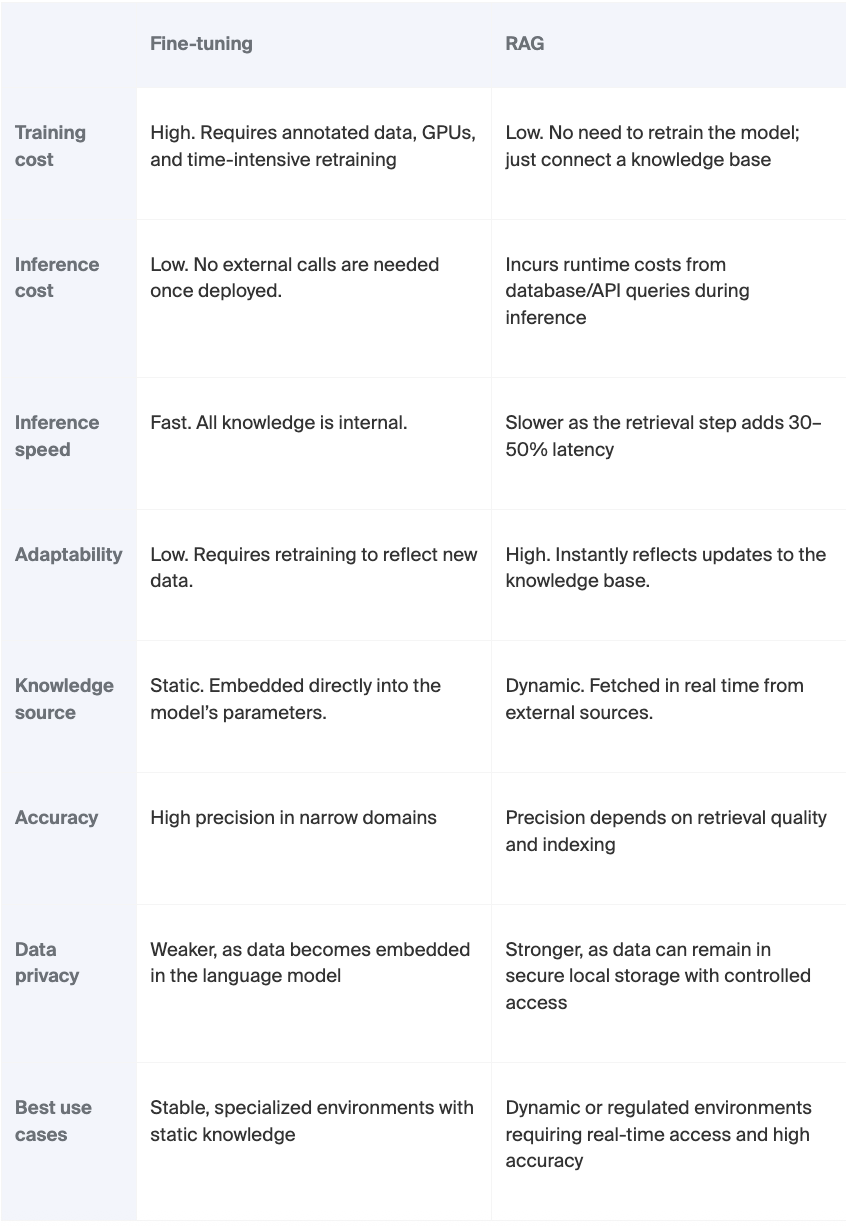
While each RAG and LLM fine-tuning intention to enhance accuracy and relevance, they achieve this in several methods – and every comes with trade-offs.
Fine-tuning entails modifying the mannequin itself by retraining it on domain-specific information. It can produce robust outcomes however is resource-intensive and rigid. And after retraining, fashions but once more grow to be static. RAG, alternatively, retains the mannequin structure intact and augments it with exterior information, enabling dynamic updates and simpler scalability.
Press enter or click on to view picture in full measurement
Press enter or click on to view picture in full measurement
Rather than viewing these approaches as mutually unique, corporations could acknowledge that the best answer typically combines each methods. For companies coping with a fancy language like authorized or medical and fast-changing details, reminiscent of regulatory updates or monetary information, a hybrid method can ship the perfect of each worlds.
And when ought to an organization think about using RAG?
Use RAG when your utility relies on up-to-date, variable, or delicate info (assume buyer help programs pulling from ever-changing information bases, monetary dashboards that should replicate present market information, or inner instruments that depend on proprietary paperwork.) RAG shines in dynamic environments the place details change typically and the place retraining a mannequin each time one thing updates is neither sensible nor cost-effective.
Impact of RAG on LLM response efficiency in real-world purposes
The implementation of RAG in LLM programs is delivering constant, measurable enhancements throughout numerous sectors. Here are real-life examples from three completely different industries that attest to the know-how’s transformative affect.
RAG LLM examples in healthcare
In the medical subject, misinformation can have critical penalties. RAG in LLMs gives evidence-based solutions by accessing the most recent medical analysis, medical tips, or affected person information.
- In diagnosing gastrointestinal situations from photos, a RAG-boosted GPT-4 mannequin achieved 78% accuracy – a whopping 24-point leap over the bottom GPT-4 mannequin – and delivered not less than one right differential prognosis 98% of the time in contrast to 92% for the bottom mannequin.
- To increase human experience in most cancers prognosis and medical analysis, IBM Watson makes use of RAG that retrieves info from medical literature and affected person information to ship therapy solutions. When examined, this technique matched knowledgeable suggestions in 96% of the instances.
- In medical trials, the RAG-powered RECTIFIER system outperformed human employees in screening sufferers for the COPILOT-HF trial, attaining 93.6% total accuracy vs. 85.9% for human consultants.
RAG LLM examples within the authorized analysis
Legal professionals spend numerous hours sifting by way of case information, statutes, and precedents. RAG supercharges authorized analysis by providing on the spot entry to related instances and guaranteeing compliance and accuracy whereas bettering employee productiveness. Here are some examples:
- Vincent AI, a RAG-enabled authorized instrument, was examined by regulation college students throughout six authorized assignments. It improved productiveness by 38%-115% in 5 out of six duties.
- LexisNexis, an information analytics firm for authorized and regulatory companies, makes use of RAG structure to continually combine new authorized priority into its LLM instruments. This permits authorized researchers to retrieve the most recent info when engaged on a case.
RAG LLM examples within the monetary sector
Financial establishments depend on real-time, correct information. Yet, conventional LLMs threat outdated or generic responses. RAG transforms finance by together with current market intelligence, bettering buyer help, and extra. Consider these examples:
- Wells Fargo deploys Memory RAG to facilitate analyzing monetary paperwork for advanced duties. The firm examined this method in the course of the earnings calls, and it displayed an accuracy stage of 91% with a median response time of 5.76 seconds.
- Bloomberg depends on RAG-driven LLMs to generate summaries of related information and monetary studies to hold its analysts and traders knowledgeable.
What are the challenges and limitations of RAG in LLMs?
Despite all the advantages, when implementing RAG in LLMs, corporations can encounter the next challenges:
- Incomplete or irrelevant retrieval. Firms can face points the place important info is lacking from the information base or solely loosely associated content material is retrieved. This can lead to hallucinations or overconfident however incorrect responses, particularly in delicate domains. Ensuring high-quality, domain-relevant information and bettering retriever accuracy is essential.
- Ineffective context utilization. Even with profitable retrieval, related info will not be correctly built-in into the LLM’s context window due to poor chunking or info overload. As a outcome, vital details might be ignored or misunderstood. Advanced chunking, semantic grouping, and context consolidation methods assist tackle this.
- Unreliable or deceptive output. With ambiguous queries and poor immediate design, RAG for LLMs can nonetheless produce incorrect or incomplete solutions, even when the suitable info is current. Refining prompts, filtering noise, and utilizing reasoning-enhanced technology strategies can enhance output constancy.
- High operational overhead and scalability limits. Deploying RAG in LLM provides system complexity, ongoing upkeep burdens, and latency. Without cautious design, it may be expensive, biased, and arduous to scale. To proactively tackle this, corporations want to plan for infrastructure funding, bias mitigation, and price administration methods.
Best practices for implementing RAG in enterprise LLM options
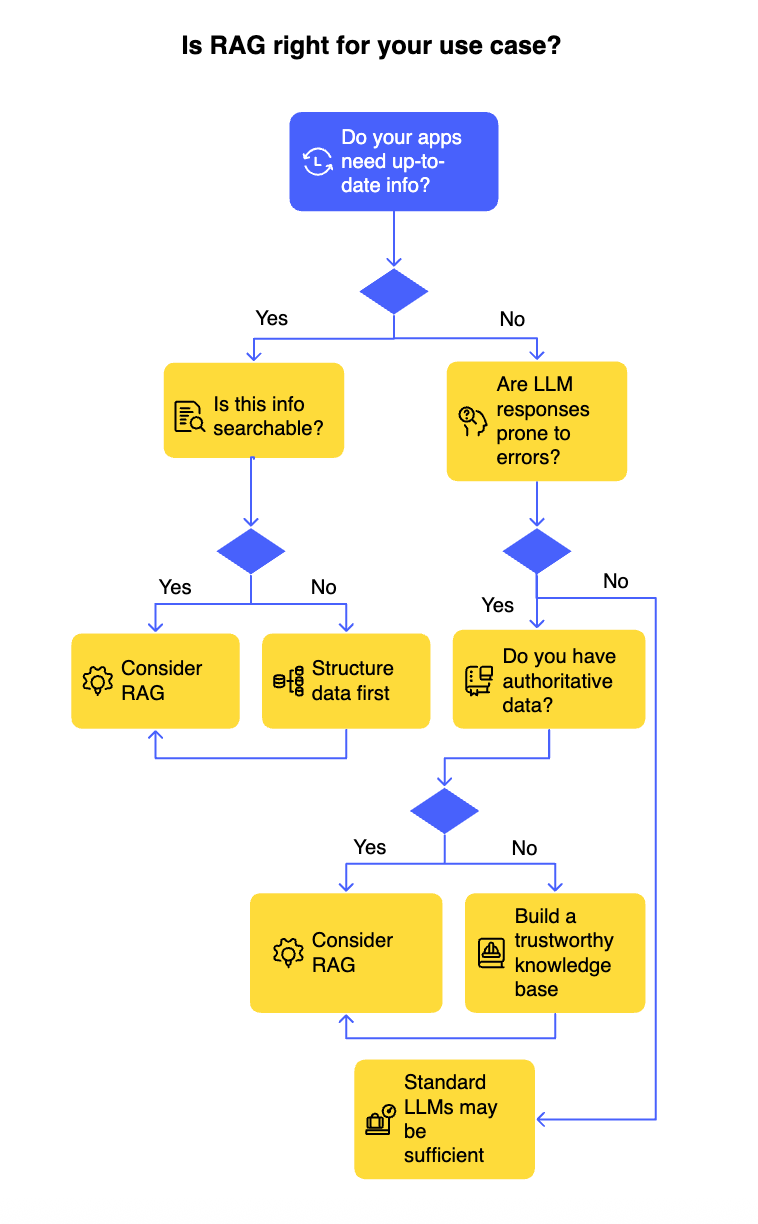
Still not sure if RAG is true for you? This easy chart will assist decide whether or not commonplace LLMs meet your wants or if RAG’s enhanced capabilities are the higher match.
Press enter or click on to view picture in full measurement
Over the years of working with AI, ITRex consultants collected a listing of useful ideas. Here are our greatest practices for optimizing RAG efficiency in LLM deployment:
Curate and clear your information base/information storage
If the underlying information is messy, redundant, not distinctive, or outdated, even essentially the most superior RAG pipeline will retrieve irrelevant or contradictory info. This undermines consumer belief and can lead to hallucinations that stem not from the mannequin, however from poor supply materials. In high-stakes environments, like finance and healthcare, misinformation can carry regulatory or reputational dangers.
To keep away from this, make investments time in curating your information storage and information base. Remove out of date content material, resolve contradictions, and standardize codecs the place attainable. Add metadata to tag doc sources and dates. Automating periodic critiques of content material freshness will hold your information base clear and reliable.
Use sensible chunking methods
Poorly chunked paperwork – whether or not too lengthy, too quick, or arbitrarily segmented – can fragment that means, strip vital context, or embody irrelevant content material. This will increase the chance of hallucinations and degrades response high quality.
The optimum chunking method varies primarily based on doc sort and use case. For structured information like authorized briefs or manuals, layout-aware chunking preserves logical movement and improves interpretability. For unstructured or advanced codecs, semantic chunking – primarily based on that means moderately than format – produces higher outcomes. As enterprise information more and more contains charts, tables, and multi-format paperwork, chunking should evolve to account for each construction and content material.
Fine-tune your embedding mannequin
Out-of-the-box embedding fashions are educated on common language, which can not seize domain-specific terminology, acronyms, or relationships. In specialised industries like authorized or biotech, this leads to mismatches, the place semantically right phrases get ignored and necessary domain-specific ideas are ignored.
To remedy this, fine-tune the embedding mannequin utilizing your inner paperwork. This enhances the mannequin’s “understanding” of your area, bettering the relevance of retrieved chunks. You may also use hybrid search strategies – combining semantic and keyword-based retrieval – to additional enhance precision.
Monitor retrieval high quality and set up suggestions loops
A RAG pipeline will not be “set-and-forget.” If the retrieval part often surfaces irrelevant or low-quality content material, customers will lose belief and efficiency will degrade. Without oversight, even strong programs can drift, particularly as your organization’s paperwork evolve or consumer queries shift in intent.
Establish monitoring instruments that observe which chunks are retrieved for which queries and how these affect last responses. Collect consumer suggestions or run inner audits on accuracy and relevance. Then, shut the loop by refining chunking, retraining embeddings, or adjusting search parameters. RAG programs enhance considerably with steady tuning.
What’s subsequent for RAG in LLMs, and how ITRex may help
The evolution of RAG know-how is much from over. We’re now seeing thrilling advances that can make these programs smarter, extra versatile, and lightning-fast. Here are three game-changing developments main the cost:
- Multimodal RAG (MRAG). This method can deal with a number of information varieties – photos, video, and audio – in each retrieval and technology, permitting LLMs to function on advanced, real-world content material codecs, reminiscent of internet pages or multimedia paperwork, the place content material is distributed throughout modalities. MRAG mirrors the best way people synthesize visible, auditory, and textual cues in context-rich environments.
- Self-correcting RAG loops. Sometimes, an LLM’s reply can diverge from details, even when RAG retrieves correct information. Self-correcting RAG loops can resolve this problem, as they dynamically confirm and modify reasoning throughout inference. This transforms RAG from a one-way information movement into an iterative course of, the place every generated response informs and improves the following retrieval.
- Combining RAG with small language fashions (SLM). This pattern is a response to the rising demand for non-public, responsive AI on gadgets like smartphones, wearables, and IoT sensors. SLMs are compact fashions, typically below 1 billion parameters, which might be well-suited for edge AI environments the place computational assets are restricted. By pairing SLMs with RAG, organizations can deploy clever programs that course of info domestically.
Ready to begin exploring RAG?
Go from AI exploration to AI experience with ITRex
At ITRex, we keep carefully tuned to the most recent developments in AI and apply them the place they take advantage of affect. With hands-on expertise in generative AI, RAG, and edge deployments, our group creates AI programs which might be as sensible as they’re modern. Whether you’re beginning small or scaling huge, we’re right here to make AI work for you.
FAQs
- What are the principle advantages of utilizing RAG in LLMs?
RAG enhances LLMs by grounding their responses in exterior, up-to-date info. This ends in extra correct, context-aware, and domain-specific solutions. It reduces the reliance on static coaching information and permits dynamic adaptation to new information. RAG additionally will increase transparency, as it may cite its sources.
- Can RAG assist cut back hallucination in AI-generated content material?
Yes, RAG reduces LLM hallucination by tying the mannequin’s responses to verified content material. When solutions are generated primarily based on exterior paperwork, there’s a decrease probability the mannequin will “make issues up.” That mentioned, hallucinations can nonetheless happen if the LLM misinterprets or misuses the retrieved content material.
- Is RAG efficient for real-time or continually altering info?
Absolutely. RAG shines in dynamic environments as a result of it may retrieve the most recent information from exterior sources on the time of question. This makes it ultimate for use instances like information summarization, monetary insights, or buyer help. Its capability to adapt in real-time offers it a significant edge over static LLMs.
- How can RAG be carried out in current AI workflows?
RAG might be built-in as a modular part alongside current LLMs. Typically, this integration entails establishing a retrieval system, like a vector database, connecting it with the LLM, and designing prompts that incorporate retrieved content material. With the suitable infrastructure, groups can regularly layer RAG onto present pipelines with no full overhaul.
Originally printed at https://itrexgroup.com on June 24, 2025.
The publish RAG for reliable AI: How to Boost LLM Response Accuracy and Reduce Hallucination appeared first on Datafloq.