

Human in the Loop – What is it and Why it Matters for ML
Human-in-the-loop is a solution to construct machine studying fashions with individuals concerned at the proper moments. In human-in-the-loop machine studying, specialists label information, assessment edge circumstances, and give suggestions on outputs. Their enter shapes objectives, units high quality bars, and teaches fashions methods to deal with gray areas. The outcome is Human-AI collaboration that retains techniques helpful and secure for actual use. Many groups deal with HITL as last-minute hand repair. That view misses the level.
HITL works finest as deliberate oversight inside the workflow. People information information assortment, annotation guidelines, mannequin coaching checks, analysis, deployment gates, and stay monitoring. Automation handles the routine. Humans step in the place context, ethics, and judgment matter. This steadiness turns human suggestions in ML coaching into regular enhancements, not one-off patches.
Here is what this text covers subsequent.
We outline HITL in clear phrases and map the place it matches in the ML pipeline. We define methods to design a sensible HITL system and why it lifts AI coaching information high quality. We pair HITL with clever annotation, present methods to scale with out shedding accuracy, and flag frequent pitfalls. We shut with what HITL means as AI techniques develop extra autonomous.
What is Human-in-the-Loop (HITL)?
Human-in-the-Loop (HITL) is a mannequin improvement strategy the place human experience guides, validates, and improves AI/ML techniques for greater accuracy and reliability. Instead of leaving information processing, coaching, and decision-making solely to algorithms, HITL integrates human experience to enhance accuracy, reliability, and security.
In follow, HITL can contain:
- Data labeling and annotation: Humans present floor reality information that trains AI fashions.
- Reviewing edge circumstances: Experts validate or right outputs the place the mannequin is unsure.
- Continuous suggestions: Human corrections refine the system over time, enhancing adaptability.
This collaboration ensures that AI techniques stay clear, honest, and aligned with real-world wants, particularly in advanced or delicate domains like healthcare, finance, or actual property. Essentially, HITL combines the effectivity of automation with human judgment to construct smarter, safer, and extra reliable AI options.
What is Human-in-the-Loop Machine Learning
Human-in-the-loop machine studying is an ML workflow that retains individuals concerned at key steps. It is greater than guide fixes. Think deliberate human oversight in information work, mannequin checks, and stay operations.
Automation has grown quick. We moved from rule-based scripts to statistical strategies, then to deep studying and at the moment’s generative fashions. Systems now be taught patterns at scale. Even so, fashions nonetheless miss uncommon circumstances and shift with new information. Labels age. Context adjustments by area, season, or coverage. That is why edge circumstances, information drift, and area quirks hold displaying up.
The value of errors is actual. Facial recognition can present bias on pores and skin tone and gender. Vision fashions in autonomous automobiles can misclassify a truck facet as open house. In healthcare, a triage rating can skew in opposition to a subgroup if coaching information lacked correct protection. These errors erode belief.
HITL helps shut that hole.
A easy human-in-the-loop structure provides individuals to mannequin coaching and assessment so selections keep grounded in context.
- Experts write labeling guidelines, pull onerous examples, and settle disputes.
- They set thresholds, assessment dangerous outputs, and doc uncommon circumstances so the mannequin learns.
- After launch, reviewers audit alerts, repair labels, and feed these adjustments into the subsequent coaching cycle.
The mannequin takes routine work. People deal with judgment, danger, and ethics. This regular loop improves accuracy, reduces bias, and retains techniques aligned with actual use.
Why HITL is important for high-quality coaching information
Human-in-the-Loop (HITL) is important for high-quality coaching information and efficient information preparation for machine studying as a result of AI fashions are solely pretty much as good as the information they be taught from. Without human experience, coaching datasets danger being inaccurate, incomplete, or biased. Automated labeling hits a ceiling when information is noisy or ambiguous. Accuracy plateaus and errors unfold into coaching and analysis.
Rechecks of in style benchmarks discovered label errors round 3 to six p.c, sufficient to flip mannequin rankings, and this is the place skilled annotators stroll into the image. HITL ensures:
- Domain experience. Radiologists for medical imaging. Linguists for NLP. They set guidelines, spot edge circumstances, and repair refined misreads that scripts miss.
- Clear escalation. Tiered assessment with adjudication prevents single-pass errors from changing into floor reality.
- Targeted effort. Active studying routes solely unsure gadgets to individuals, which raises sign with out bloating value.
Quality field: GIGO in ML
- Better labels result in higher fashions.
- Human suggestions in ML coaching breaks error propagation and retains datasets aligned with real-world that means.
Here’s proof that it works:
- Re-labeled ImageNet. When researchers changed single labels with human-verified units, reported features shrank and some mannequin rankings modified. Cleaner labels produced a extra devoted check of actual efficiency.
- Benchmark audits. Systematic critiques present that small fractions of mislabelled examples can distort each analysis and deployment decisions, reinforcing the want for human in the loop on high-impact information.
Human-in-the-loop machine studying affords deliberate oversight that upgrades coaching information high quality, reduces bias, and stabilizes mannequin habits the place it counts.
Challenges and issues in implementing HITL
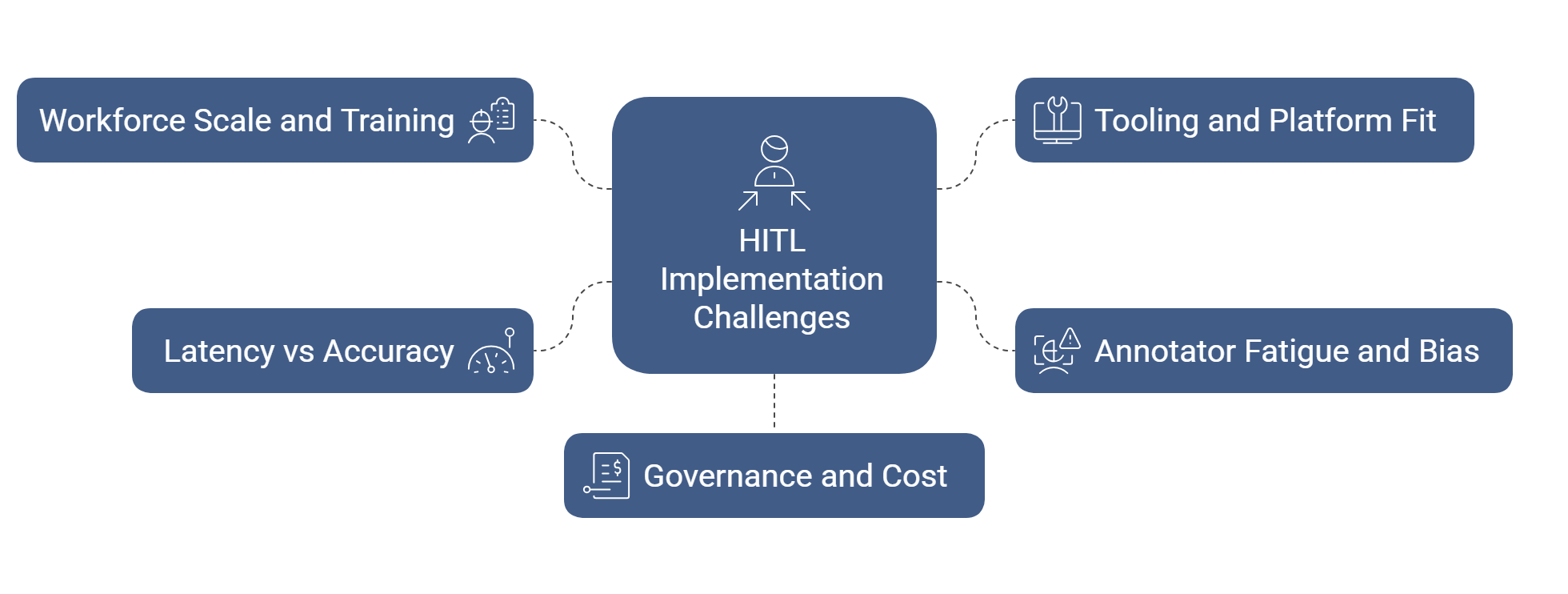
Implementing Human-in-the-Loop (HITL) comes with challenges equivalent to scaling human involvement, making certain constant information labeling, managing prices, and integrating suggestions effectively. Organizations should steadiness automation with human oversight, tackle potential biases, and keep information privateness, all whereas designing workflows that hold the ML pipeline each correct and environment friendly.
- Workforce scale and coaching:
You want sufficient skilled annotators at the proper time. Create clear guides, quick coaching movies, and fast quizzes. Track settlement charges and give quick suggestions so high quality improves week by week. - Tooling and platform match:
Check that your labeling device speaks your stack. Support for versioned schemas, audit trails, RBAC, and APIs retains information transferring. If you construct customized instruments, finances for ops, uptime, and person help. - Annotator fatigue and bias:
Long queues and repetitive gadgets decrease accuracy. Rotate duties, cap session size, and combine simple with onerous examples. Use blind assessment and battle decision to cut back private bias and groupthink. - Latency vs accuracy in actual time:
Some use circumstances want instantaneous outcomes. Others can wait for assessment. Triage by danger. Route solely high-risk or low-confidence gadgets to people. Cache selections and reuse them to chop delay. - Governance and value:
Human-in-the-loop machine studying wants clear possession. Define acceptance standards, escalation paths, and finances alerts. Measure label high quality, throughput, and unit value so leaders can commerce velocity for accuracy with eyes open.
How to design an efficient human-in-the-loop system
Start with selections, not instruments.
List the factors the place judgment shapes outcomes. Write the guidelines for these moments, agree on high quality targets, and match human-in-the-loop machine studying into that path. Keep the loop easy to run and simple to measure.
Use the proper varieties of knowledge labeling
Use expert-only labeling for dangerous or uncommon lessons. Add model-assist the place the system pre-fills labels and individuals verify or edit. For onerous gadgets, accumulate two or three opinions and let a senior reviewer resolve. Bring in gentle programmatic guidelines for apparent circumstances, however hold individuals in cost of edge circumstances.
Installing HITL in your organization
- Pick one high-value use case and run a brief pilot.
- Write pointers with clear examples and counter-examples.
- Set acceptance checks, escalation steps, and a service degree for turnaround.
- Wire lively studying so low-confidence gadgets attain reviewers first.
- Track settlement, latency, unit value, and error themes.
- When the loop holds regular, broaden to the subsequent dataset utilizing the similar HITL structure in AI.
Is a human in the loop system scalable?
Yes, in case you route by confidence and danger. Here’s how one can make the system scalable:
- Auto-accept clear circumstances.
- Send medium circumstances to skilled reviewers.
- Escalate solely the few which might be excessive affect or unclear.
- Use label templates, ontology checks, and periodic audits to maintain consistency as quantity grows.
Better uncertainty scores will goal critiques extra exactly. Model-assist will velocity video and 3D labeling. Synthetic information will assist cowl uncommon occasions, however individuals will nonetheless display it. RLHF will lengthen past textual content to policy-heavy outputs in different domains.
For moral and equity checks, begin writing bias-aware guidelines. Sample by subgroup and assessment these slices on a schedule. Use various annotator swimming pools and occasional blind critiques. Keep audit trails, privateness controls, and consent information tight.
These steps hold human-AI collaboration secure, traceable, and match for actual use.
Looking forward: HITL in a way forward for autonomous AI
Models are getting higher at self-checks and self-corrections. They will nonetheless want guardrails. High-stakes calls, long-tail patterns, and shifting insurance policies name for human judgment.
Human enter will change form. More immediate design and coverage organising entrance. More suggestions curation and dataset governance. Ethical assessment as a scheduled follow, not an afterthought. In reinforcement studying with human suggestions, reviewers will concentrate on disputed circumstances and security boundaries whereas instruments deal with routine rankings.
HITL is not a fallback. It is a strategic accomplice in ML operations: it units requirements, tunes thresholds, and audits outcomes so techniques keep aligned with actual use.
Deeper integrations with labeling and MLOps instruments, richer analytics for slice-level high quality, and a specialised workforce by area and job sort. The purpose is easy: hold automation quick, hold oversight sharp, and hold fashions helpful as the world adjustments.
Conclusion
Human in the loop is the base of reliable AI as it retains judgment in the workflow the place it issues. It turns uncooked information into dependable alerts. With deliberate critiques, clear guidelines, and lively studying, fashions be taught sooner and fail safer.
Quality holds as you scale as a result of individuals deal with edge circumstances, bias checks, and coverage shifts whereas automation does the routine. That is how information turns into intelligence with each scale and high quality.
If you’re selecting a accomplice, decide one which embeds HITL throughout information assortment, annotation, QA, and monitoring. Ask for measurable targets, slice-level dashboards, and actual escalation paths. That is our mannequin at HitechDigital. We construct and run HITL loops finish to finish so your techniques keep correct, accountable, and prepared for actual use.
The publish Human in the Loop – What is it and Why it Matters for ML appeared first on Datafloq.