
Federated Learning: Your Guide to Collaborative AI
TL;DR
- What is federated studying? A privacy-first AI method the place a number of events collaboratively practice a shared mannequin with out sharing uncooked knowledge – excellent for domains like healthcare, finance, and IoT.
- In federated studying, a central AI mannequin is distributed to native gadgets or servers, skilled on native knowledge, and solely updates (not knowledge) are returned. These updates will be encrypted utilizing safe aggregation or different privacy-preserving strategies.
- Key implementation challenges embody knowledge heterogeneity, communication overhead, mannequin convergence points, and governance complexities
Artificial intelligence (AI) guarantees sharper insights, quicker choices, and leaner operations. Every group needs in.
But AI thrives on knowledge. Yet most of that knowledge is delicate, and international rules like GDPR, HIPAA, and CCPA are tightening the principles on the way it’s dealt with.
Traditional AI techniques require all knowledge to be pulled into one place. That’s dangerous. It creates privateness publicity, compliance complications, and severe reputational threats. For enterprise leaders, it’s a troublesome selection: unlock the total energy of AI or play it protected with knowledge.
Federated studying gives a brand new path – one which protects knowledge privateness with out slowing innovation.
In this text, our AI consultants clarify what federated studying is, the way it can assist what you are promoting, and which challenges to count on throughout implementation.
The way forward for data-driven progress is non-public. And it’s already right here.
What is federated studying, and the way does it work?
With federated studying, it’s AI that travels – your knowledge stays safely the place it’s.
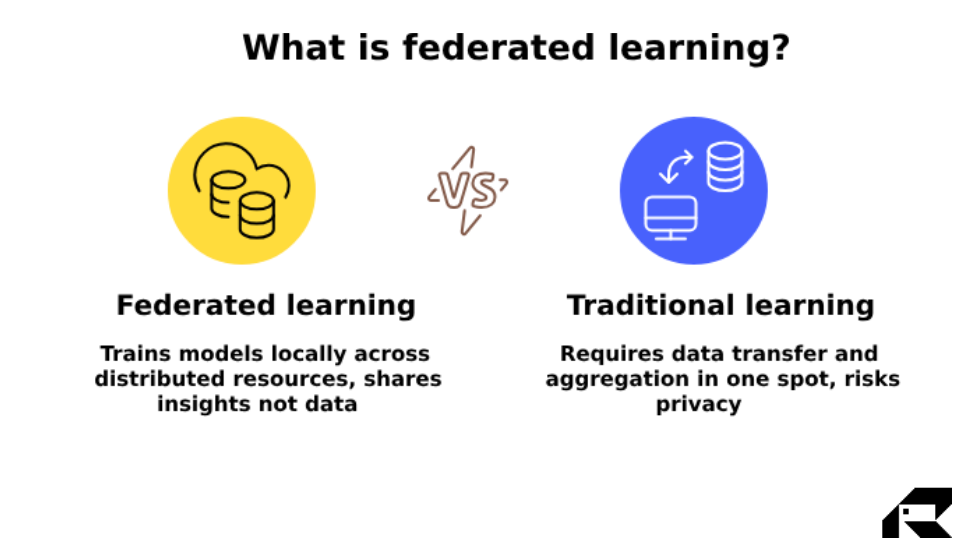
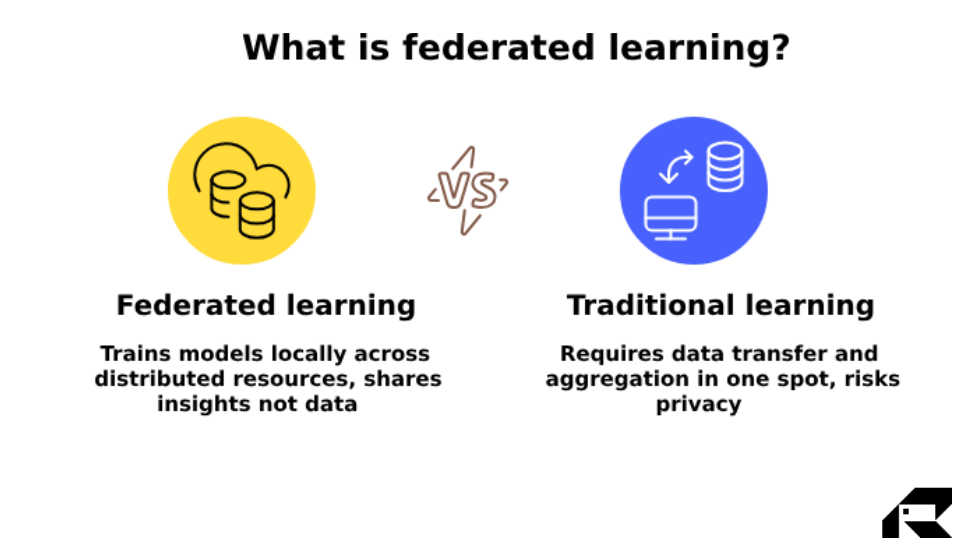
Traditionally, coaching an AI mannequin meant gathering all of your knowledge in a single central place – typically a cloud server – earlier than the training might start. That strategy creates vital privateness dangers, regulatory challenges, and operational bottlenecks.
Federated studying flips this script.
Instead of shifting your knowledge, it strikes the mannequin.
Federated studying definition
So, what’s federated studying in AI?
Federated studying is a privacy-preserving machine studying strategy that permits a number of events to collaboratively practice a shared AI mannequin with out transferring or exposing their underlying knowledge.
The AI mannequin is distributed out to the place the info already lives – on servers, edge gadgets, or inside completely different departments or enterprise models. Each participant trains the mannequin domestically. Only the realized insights (mannequin updates, not the precise knowledge) are then despatched again to the central server, the place they’re mixed into a better, extra correct mannequin.
Your knowledge stays precisely the place it’s, considerably lowering privateness dangers. In a analysis undertaking analyzing over 3,000 federated studying deployments throughout completely different sectors, the individuals reported an 87.2% enchancment in GDPR compliance.
Press enter or click on to view picture in full dimension
Consider this analogy
To perceive federated studying higher, contemplate an analogy of a touring professor. A world-class professor is educating college students in several cities. Instead of flying all the scholars to one college (centralizing the info), the professor travels to every location, provides lectures, and learns from every group. She then compiles the findings from every metropolis to enhance her total course.
No one had to depart their hometown, and nobody shared their private story past the classroom. That’s federated studying in motion.
Types of federated studying
Participants can construction federated studying in several methods relying on how the info is distributed and the way coordination is managed. Understanding these approaches is vital to deciding on the fitting mannequin on your group or ecosystem.
1. Centralized federated studying
In this structure, a number of individuals practice a shared mannequin domestically on their knowledge and ship updates to a central coordinating server. The server aggregates the insights and updates the worldwide mannequin.
Best for organizations with a hub-and-spoke construction or clear central authority, akin to company headquarters coordinating throughout branches or subsidiaries.
2. Decentralized federated studying
This strategy doesn’t depend on a central server. Participants share mannequin updates straight with one another in a peer-to-peer style. This setup will increase robustness and reduces single factors of failure.
Best for consortiums or partnerships the place no single celebration needs – or is allowed – to function the central coordinator.
3. Cross-silo federated studying
This federated studying sort is perfect when just a few trusted, long-term individuals, like departments inside an organization or enterprise companions, collaborate. The knowledge stays siloed for authorized, moral, or operational causes, however the organizations nonetheless profit from a joint mannequin.
Best for enterprises collaborating throughout enterprise models or organizations with aligned targets (e.g., banks combating fraud collectively).
How federated studying works: a cycle of steady intelligence
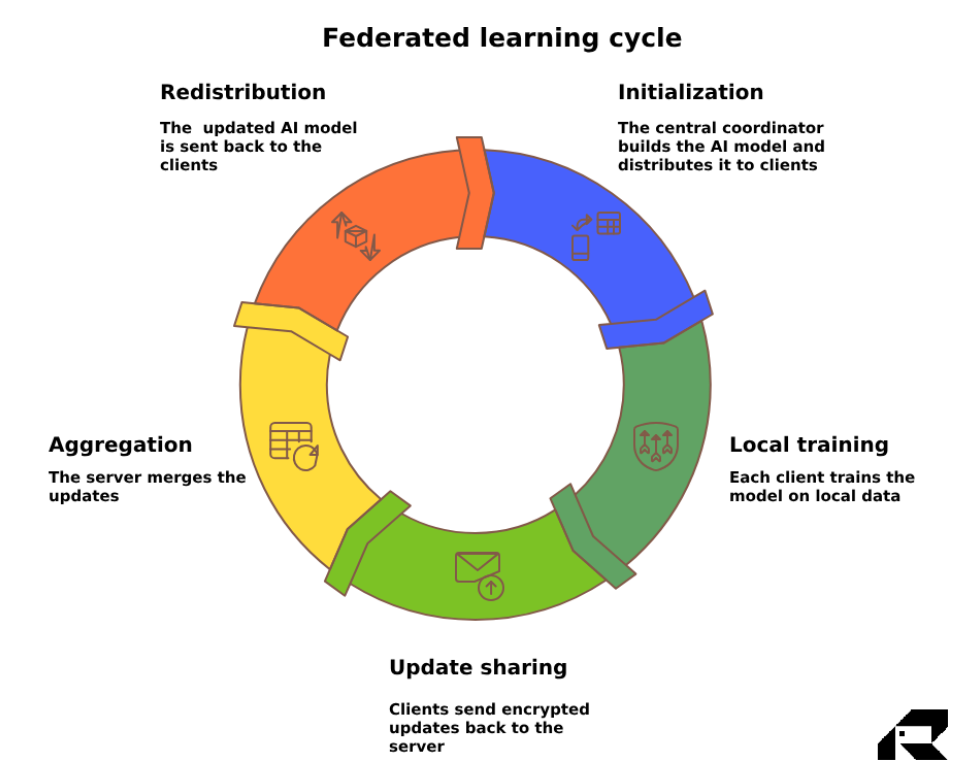
Federated studying operates via an iterative, privacy-first coaching cycle, permitting organizations to construct highly effective AI fashions with out ever exchanging delicate knowledge.
Here’s how federated studying operates, step-by-step:
Step 1: Initialization. Distributing the blueprint
Federated studying begins with a central coordinator creating an preliminary model of the AI mannequin. This mannequin is distributed out to a gaggle of taking part entities, known as individuals. These is likely to be inside enterprise models, accomplice organizations, department workplaces, and even edge gadgets like smartphones or IoT sensors.
Step 2: Local coaching. Intelligence on the supply
Each participant receives the mannequin and trains it independently utilizing solely their very own native knowledge. During this stage, the AI mannequin learns from the distinctive patterns inside every dataset – whether or not it’s buyer habits, transaction historical past, or operational metrics – creating localized intelligence with out threat of information publicity.
Step 3: Update sharing. Sharing insights, not info
After native coaching, the individuals don’t ship their knowledge to the coordinator. They ship solely the mannequin updates – the refined parameters that mirror what the mannequin has realized. These updates are sometimes smaller than uncooked knowledge and will be encrypted and compressed utilizing extra strategies, defending each privateness and bandwidth.
Step 4: Aggregation. Combining intelligence securely
The central coordinator collects all these encrypted updates and intelligently combines them into an improved international mannequin. The coordinator goals to steadiness enter from all shoppers pretty, utilizing devoted strategies, akin to federated averaging. To strengthen privateness even additional, superior strategies, akin to safe aggregation, be certain that even throughout this step, nobody can reverse-engineer particular person contributions.
Step 5: Redistribution. Smarter mannequin again within the area
The enhanced international mannequin is redistributed to all individuals. With every cycle, the mannequin turns into extra correct, extra adaptive, and extra invaluable. This steady loop permits your AI techniques to evolve in real-time, studying from reside knowledge with out ever centralizing it.
Press enter or click on to view picture in full dimension
Federated studying frameworks
Federated studying requires extra than simply a good suggestion – it calls for the fitting instruments to coordinate distributed mannequin coaching, guarantee knowledge privateness, and scale throughout complicated environments. That’s the place federated studying frameworks are available in. Here are three main frameworks enabling sensible, privacy-first AI at this time:
TensorFlow Federated (TFF)
Developed by Google, this open-source framework is constructed for large-scale, cross-device federated studying, particularly in cellular and edge environments. It offers a standard framework for each analysis and manufacturing, providing a high-level federated studying API for researchers and practitioners, in addition to a lower-level federated core API for extra granular management.
TFF integrates with the broader TensorFlow ecosystem and helps simulation, differential privateness, and safe aggregation. TFF additionally contains sturdy simulation capabilities for testing algorithms in managed environments and helps customizable aggregation algorithms like federated averaging.
Ideal for enterprises already utilizing TensorFlow, particularly for consumer-facing apps, cellular options, or edge AI.
PySyft
This federated studying framework is an open-source Python library created by OpenMined. PySyft is targeted on privacy-preserving machine studying. It helps federated studying, safe multiparty computation, and differential privateness and integrates with each PyTorch and TensorFlow.
Ideal for extremely delicate sectors that want sturdy privateness ensures, like healthcare and finance, and for integrating with present PyTorch or TensorFlow workflows.
Flower (FLwr)
Flower is a light-weight, open-source federated studying framework designed for optimum flexibility. Its key benefit is supporting a number of ML libraries (PyTorch, TensorFlow, and scikit-learn). Flower scales effectively throughout numerous environments and works throughout cellular, embedded, and cloud-based techniques. It’s language- and ML framework-agnostic, which permits engineers to port present workloads with minimal overhead and offers researchers with the flexibleness to experiment with novel approaches.
Ideal for fast prototyping, analysis, and scalable manufacturing throughout numerous ML frameworks.
Federated studying: real-world strategic affect
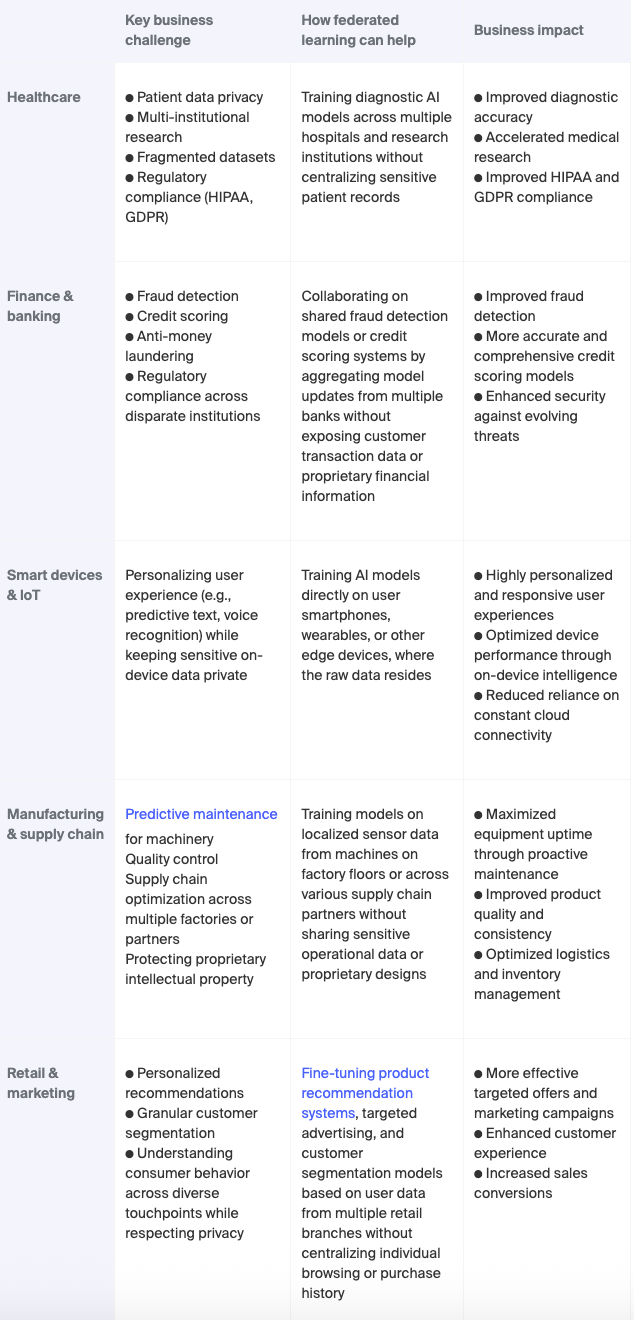
Federated studying isn’t a theoretical idea; it’s a confirmed, actively deployed expertise that’s remodeling industries at this time. Below are some strategic federated studying functions in several industries.
Federated studying examples
- Healthcare
Johns Hopkins led the FLARE undertaking, the place 42 hospitals throughout 12 nations participated in federated studying. They skilled AI fashions on a mixed dataset of 6.3 million medical photographs with out ever exchanging uncooked affected person knowledge. The undertaking achieved a outstanding 94.2% diagnostic accuracy in detecting pulmonary embolism.
- Finance and banking
When examined in real-life settings, a federated learning-enabled AI mannequin demonstrated a 28.7% enchancment in fraud detection accuracy and a 93.7% discount in non-public knowledge publicity in contrast to conventional strategies. In one other experiment, an AI mannequin skilled via federated studying might detect fraud with a 15%-30% increased accuracy.
- Smart gadgets and IoT
Google makes use of federated studying to enhance autocorrect performance on its Gboard keyboard. To preserve energy and bandwidth, coaching solely happens when a tool is idle – charging and linked to Wi-Fi. Apple additionally applies this expertise to refine Siri’s voice recognition, making certain person knowledge like voice instructions and search historical past stay on the gadget.
- Manufacturing
Siemens reworked its printed circuit board (PCB) manufacturing high quality management utilizing federated studying. Facing strict knowledge privateness necessities throughout its international manufacturing community, the corporate carried out a collaborative AI answer that allowed a number of amenities to collectively practice anomaly detection fashions with out ever sharing delicate manufacturing knowledge. The firm deployed the ensuing mannequin at two manufacturing websites and witnessed an accuracy of 98% in anomaly detection, in contrast to 84% for a similar mannequin earlier than retraining.
- Retail
A significant style model confronted a expensive problem: lowering excessive clothes return charges attributable to inaccurate dimension suggestions. To resolve this problem with out compromising buyer privateness, they adopted federated studying, enabling their AI mannequin to study from regional match preferences and particular person buy histories whereas conserving all knowledge decentralized. In pilot testing, the mannequin delivered a 35% enchancment in dimension advice accuracy, serving to clients discover their excellent match.
Federated studying implementation challenges: what to be careful for
While federated studying gives highly effective advantages, implementing it at scale isn’t with out hurdles. Many of the identical qualities that make this strategy interesting, akin to knowledge decentralization, privateness preservation, and cross-organization collaboration, additionally introduce distinctive complexities.
So, what are the challenges of federated studying implementation?
Part 1: Technical challenges in federated studying
Implementing federated studying at scale introduces a variety of technical complexities that differ considerably from conventional AI workflows.
Challenge 1: Data & system heterogeneity
In federated studying, every taking part gadget or group typically has distinctive datasets and system environments. This means knowledge is never distributed evenly or constantly. It’s typically non-independent and identically distributed (non-IID). For instance, one automotive plant would possibly accumulate steady, real-time engine efficiency metrics, whereas one other solely captures threshold-based fault codes throughout routine upkeep.
At the identical time, the gadgets themselves – whether or not smartphones, edge sensors, or enterprise servers – have broadly various computing energy, reminiscence, community connectivity, and uptime. Some are always-on, high-performance machines. Others could also be battery-powered gadgets with restricted connectivity. This variation in computing energy, reminiscence, and community reliability leads to vital variations in how shortly and reliably shoppers can full native coaching duties.
How ITRex can assist
We design adaptive aggregation methods, fine-tune native replace schedules, and apply superior strategies like customized federated studying and area adaptation. Our engineers additionally optimize runtime environments to accommodate various gadget capabilities, making certain inclusivity with out sacrificing efficiency.
Challenge 2: Communication overhead & infrastructure constraints
Federated studying requires fixed communication between a central coordinator and numerous distributed shoppers. In observe, this implies mannequin updates (even when small) are exchanged throughout 1000’s, and even hundreds of thousands, of gadgets in each coaching spherical. In cellular and IoT environments, this will create terabytes of information site visitors, leading to severe bandwidth pressure, excessive latency, and unsustainable operational prices.
Moreover, communication protocols typically depend on synchronous updates. Meaning all chosen shoppers should report again earlier than aggregation can happen. But in real-world deployments, shoppers could also be offline, underpowered, or on unstable networks. This can halt coaching completely or introduce unacceptable delays.
How ITRex can assist
We deploy communication-efficient protocols akin to mannequin replace compression, quantization, and asynchronous coaching workflows that remove bottlenecks and cut back bandwidth dependency. Our workforce additionally helps architect hybrid edge-cloud infrastructures to optimize knowledge circulation even in low-connectivity environments.
Challenge 3: Model convergence & high quality management
In federated studying, reaching steady, high-quality mannequin convergence is way harder than in centralized machine studying. This is due to each knowledge and techniques heterogeneity, which trigger native fashions to “drift” in several instructions. When these native updates are aggregated, the ensuing international mannequin might converge slowly or by no means. There’s additionally the danger of “catastrophic forgetting,” the place a mannequin loses beforehand realized data because it adapts to new knowledge.
Another problem is validation. Since uncooked knowledge stays on shopper gadgets, it’s tough to set up a single floor fact to monitor studying progress.
How ITRex can assist
We implement sturdy aggregation strategies (e.g., FedProx, adaptive weighting), develop good participant choice insurance policies, and design simulation environments that approximate convergence beneath real-world circumstances. To deal with validation blind spots, we apply privacy-preserving analysis strategies that provide you with visibility into mannequin efficiency with out violating compliance.
Part 2: Business & organizational hurdles in federated studying
Beyond the technical structure, federated studying introduces complicated enterprise, authorized, and operational dynamics.
Challenge 4: Privacy & safety vulnerabilities
While federated studying is well known for preserving privateness by conserving uncooked knowledge native, it’s not immune to exploitation. The alternate of mannequin updates (e.g., gradients or weights) between shoppers and the central server introduces a brand new assault floor. Sophisticated adversaries can launch inference assaults to reverse-engineer delicate enter knowledge or establish taking part customers. In extra extreme circumstances, attackers might inject malicious updates that distort the worldwide mannequin for private or aggressive achieve.
Unlike conventional centralized techniques, federated environments are uniquely susceptible to insider threats, the place compromised or malicious individuals submit dangerous updates. Simultaneously, individuals should belief that the central server isn’t misusing their contributions.
How ITRex can assist
We take a multi-layered safety strategy, combining differential privateness, safe aggregation protocols, and anomaly detection strategies to monitor for irregular shopper habits. We additionally implement sturdy aggregation algorithms that neutralize malicious inputs and supply cryptographic protections.
Challenge 5: Governance & stakeholder alignment
Federated studying turns AI right into a collaborative train, however collaboration with out governance leads to friction. In cross-company or cross-department deployments, possession and accountability turn into a problem. Who holds mental property rights to the collectively skilled mannequin? Who is liable if it produces biased or incorrect outcomes? What occurs if a participant decides to exit the federation and calls for their knowledge be faraway from the mannequin?
To complicate issues much more, AI rules, just like the EU AI Act, are evolving quickly, typically introducing strict obligations round transparency and equity. Also, merely deleting a accomplice’s knowledge doesn’t essentially take away their affect on the mannequin except the remaining shoppers retrain the mannequin from scratch, which is dear and impractical.
How we assist
We help you in establishing clear federated studying governance frameworks earlier than deployment begins. This contains defining IP possession, legal responsibility, mannequin contribution rights, and participant exit protocols. For superior use circumstances, we provide mannequin unwind strategies to reverse the affect of eliminated knowledge, avoiding the necessity for expensive full retraining.
Partner with ITRex to implement federated studying with confidence
While federated studying gives clear strategic benefits, placing it into observe takes extra than simply organising the expertise. Organizations want to handle complicated knowledge environments, put sturdy governance in place, and deal with the distinctive dangers that include working distributed AI techniques. Many firms don’t have these capabilities in-house and want to search for an exterior AI improvement accomplice.
Our experience in guiding your federated studying journey
ITRex makes a speciality of translating the profound promise of federated studying into tangible enterprise worth on your group. We supply:
- Robust AI governance and coverage improvement. Our knowledge technique consultants design sturdy governance fashions to guarantee accountable, compliant AI use.
- Secure structure design and implementation. We construct scalable, safe federated studying techniques tailor-made to your infrastructure, making use of superior privateness strategies and our confirmed cross-industry AI and Gen AI experience.
- Risk mitigation and bias administration. Our workforce proactively addresses threats like knowledge leakage, poisoning, and bias, constructing honest, clear, and high-performing fashions.
- Pilot program technique and scaling. We lead federated studying pilot packages and AI proof-of-concept (PoC) tasks that show actual worth, then scale them throughout your enterprise. You can discover extra about our AI PoC providers right here.
FAQs
- How does federated studying enhance privateness in AI techniques?
Federated studying enhances privateness by conserving uncooked knowledge on native gadgets or servers, sharing solely encrypted mannequin updates. This minimizes publicity dangers and helps compliance with rules like GDPR and HIPAA.
- How does federated studying differ from conventional centralized machine studying?
Unlike centralized machine studying, which requires aggregating all knowledge in a single location, federated studying trains AI fashions throughout distributed sources. It brings the mannequin to the info – lowering knowledge motion, enhancing safety, and enabling cross-organizational collaboration with out sharing proprietary info.
- How does federated studying deal with imbalanced or skewed knowledge distributions?
Federated studying can battle with uneven or biased knowledge throughout individuals. But there are superior aggregation strategies and personalization methods to assist steadiness contributions and enhance total mannequin equity and efficiency. These strategies embody federated averaging (combines mannequin updates from every participant, weighted by the quantity of native knowledge), federated proximal (provides a regularization time period to cut back the affect of outlier participant updates and stabilize coaching when knowledge throughout individuals may be very completely different), and clustering-based aggregation (teams individuals with related knowledge patterns and aggregates their updates individually earlier than merging).
Originally revealed at https://itrexgroup.com on July 10, 2025.
The publish Federated Learning: Your Guide to Collaborative AI appeared first on Datafloq.