
Using artificial intelligence (AI) in inventory administration: practical tips
Inventory inefficiency quietly drains profitability. Slow-moving elements – not often bought however contractually required – usually make up 10-40% of whole inventory, tying up thousands and thousands in working capital. Maintaining this extra inventory provides additional pressure via storage prices, insurance coverage, and administrative overhead. Every greenback locked in out of date or pointless inventory is a greenback that may’t be reinvested in development, innovation, or customer support.
That’s why extra enterprises are turning to AI consulting companions to carry intelligence into their inventory. Through predictive analytics, automation, and real-time insights, they’re chopping waste, boosting agility, and reclaiming locked-up capital.
This article explores the functions of AI in inventory administration – from demand forecasting and real-time visibility to warehouse automation and structure optimization. It additionally outlines practical steps for strategic AI implementation, serving to organizations flip inventory from a price burden right into a supply of aggressive benefit.
Key use instances of AI in inventory administration
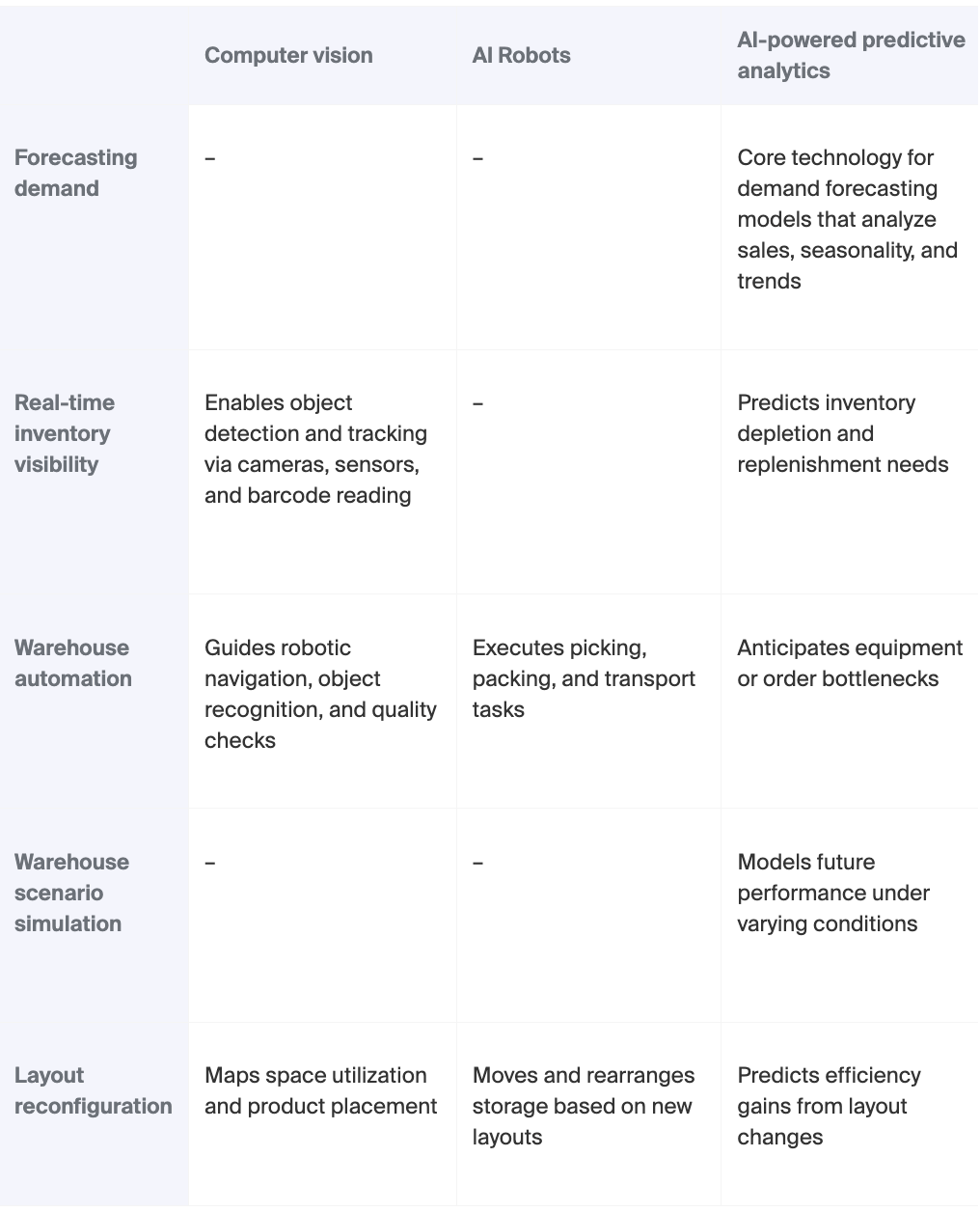
Different AI applied sciences work collectively to rework inventory administration. The desk under reveals how AI is used in inventory administration, revealing the distinct roles of laptop imaginative and prescient, robotics, predictive analytics, AI brokers, and generative AI throughout warehouse operations.
Press enter or click on to view picture in full dimension

Let’s dive into extra particulars and real-life examples of AI in inventory administration.
1. Forecasting demand
AI fashions for demand forecasting in inventory administration empower firms to foretell buyer wants with distinctive accuracy. By analyzing historic gross sales, seasonality, promotions, and even exterior variables like climate, market sentiment, and financial tendencies, these fashions uncover patterns conventional strategies miss. AI-powered predictive analytics repeatedly refine their predictions as new information flows in, serving to companies preserve optimum inventory ranges.
Real-life examples:
FLO is a Turkish footwear retailer with operations in 25 international locations. The firm collaborated with Invent.ai to foretell demand and optimize inventory throughout its areas. With this innovation, FLO elevated product availability from 71% to 94% and diminished out-of-stocks from 15% to a mere 3%.
2. Real-time inventory visibility
Using AI for real-time inventory monitoring offers companies an correct, always-on view of their inventory throughout warehouses, shops, and success facilities. Computer imaginative and prescient methods determine and rely merchandise via cameras and sensors, immediately detecting discrepancies or misplaced objects. Predictive analytics anticipates inventory depletion and replenishment wants, serving to stop shortages earlier than they occur. Meanwhile, generative AI enhances visibility on the digital facet by robotically producing product descriptions and updating on-line catalogs as new objects enter the system.
Together, these applied sciences get rid of blind spots, making certain that inventory information stays synchronized, dependable, and actionable throughout each channel. And in an AIoT (artificial intelligence of issues) setup, AI fashions don’t simply accumulate information: they interpret it and set off quick actions, akin to alerting workers or initiating recounts.
Real-life instance:
Here is one AI inventory administration case research in e-commerce.
Pincode, a big eCommerce platform, struggled with inventory visibility and catalog updates as completely different small retailers uploaded their merchandise till they began utilizing OpenAI’s fashions. Through an API, the chosen mannequin analyzes product photos and gross sales payments to determine merchandise particulars and replace inventory robotically – eliminating tedious guide work. As a outcome, Pincode elevated real-time inventory visibility whereas chopping guide effort by 20% and boosted fulfilled orders by 8%.
3. Warehouse automation
Press enter or click on to view picture in full dimension

Companies can deploy fleets of robots powered by laptop imaginative and prescient and machine studying to choose, transfer, and pack items with excessive precision. Alongside them, AI brokers act as digital coordinators – analyzing real-time information to assign duties, steadiness workloads, and synchronize folks, machines, and inventory flows. Together, these AI inventory administration applied sciences create warehouses that suppose and act autonomously, optimizing routes, predicting upkeep wants, and reconfiguring workflows on the fly to maintain tempo with demand.
Real-life instance:
An on-line grocery retailer, Ocado, has absolutely automated warehouses showcasing Industry 4.0 in motion. There, robotics, IoT, and AI work collectively to course of 50,000 orders in 5 minutes. Robots navigate warehouse grids, selecting and delivering bins with precision, whereas machine studying prevents collisions, optimizes routes, and predicts upkeep wants.
4. Warehouse situation simulation
AI-driven warehouse situation simulation empowers firms to make smarter operational choices earlier than actuality exams them. By modeling labor and gear utilization underneath varied demand patterns, AI helps managers determine bottlenecks, steadiness workloads, and plan shifts extra effectively – particularly throughout peak intervals. Demand and inventory stress testing permits groups to simulate disruptions, akin to provider delays or sudden demand surges, and gauge how these situations have an effect on service ranges and prices.
AI-powered simulations rework inventory administration from reactive firefighting to proactive optimization, making certain that assets, inventory, and individuals are at all times aligned with real-world volatility.
Real-life instance:
Aiming to streamline operations, DHL deployed AI-powered warehouse modeling to match completely different order selecting methods. The optimum technique enabled HDL to reduce order completion time by 8.2%. The mannequin additionally recognized idle assets and elevated warehouse useful resource utilization by roughly 10%.
5. Warehouse structure reconfiguration
Instead of counting on static layouts or annual reconfigurations, AI in inventory administration repeatedly analyzes order patterns, product velocity, and materials movement to advocate smarter preparations of storage zones, selecting areas, and gear paths. It identifies congestion factors, predicts the place future demand surges will happen, and fashions how modifications will influence product placements.
The result’s a warehouse that evolves dynamically – lowering journey time, enhancing area utilization, and chopping labor prices – with out the disruption of trial-and-error rearrangement.
Real-life instance:
JD Logistics operates three absolutely automated, AI-powered warehouses in California. When a supply truck arrives, an clever container transport unit (CTU) system instantly takes over – offloading items, figuring out optimum placement for every package deal, and grouping them effectively for storage or dispatch. According to the corporate, this AI-driven system has boosted warehouse effectivity by 300%.
What are the advantages of AI inventory administration software program?
Press enter or click on to view picture in full dimension

Here are the highest 4 quantifiable advantages decision-makers can count on from strategic AI in inventory administration implementation:
- Minimizing stockouts by as much as 65%. Missed gross sales and empty cabinets erode buyer belief and income. AI predicts demand surges in actual time, identifies provide dangers early, and dynamically reallocates inventory to maintain merchandise obtainable when and the place they’re wanted.
- Cutting forecast errors by 20-50%. Traditional forecasting fashions can’t course of the hundreds of variables (e.g., climate, social tendencies, rivals’ pricing, and so forth.) that affect demand. Modern methods use AI that’s highly effective sufficient to combine all these parameters.
- Reducing extra inventory by 20-30%. Excess inventory locks up money and results in pricey write-offs. AI spots slow-moving or dangerous merchandise early and adjusts ordering to forestall overstocking.
- Automating redundant guide duties. AI can automate tedious and monotonous guide duties and carry out them with greater accuracy. For occasion, Starbucks moved from rare guide counts to eight instances extra frequent AI-assisted scanning, delivering higher visibility and fewer surprises.
Press enter or click on to view picture in full dimension

Strategic adoption of AI in inventory administration: practical tips from ITRex
Implementing AI in inventory administration requires greater than adopting new instruments; it calls for a transparent technique, disciplined execution, and robust alignment between expertise and enterprise objectives. The following steps will enable you to transfer from experimentation to enterprise-scale influence.
Tip #1: Establish AI-ready information basis
Artificial intelligence in inventory administration depends upon clear, linked, and repeatedly up to date information. Fragmented ERP, warehouse administration methods, and different information sources usually stop visibility throughout the availability chain, limiting what AI can be taught and predict. In such circumstances, even probably the most superior algorithms will underperform.
Action
Begin by breaking down silos, integrating information from each related supply, and making ready it for AI consumption.
At ITRex, we provide information platform consulting companies to assist enterprises design and implement strong information architectures that guarantee accuracy, governance, and real-time visibility. This information basis is what transforms inventory administration from a reactive price heart right into a predictive revenue driver.
Tip #2: Start with a focused, contained pilot undertaking
The quickest path to demonstrating worth from AI in inventory administration is thru a centered, low-risk pilot. Instead of a high-risk “rip and change” initiative, you can begin small – testing AI on one crucial use case the place outcomes may be clearly measured. This strategy builds inside momentum and reduces the danger of overextension.
Action
Launch a pilot specializing in a selected alternative, akin to enhancing demand forecasts on your most risky 10% of SKUs or automating replenishment in a single high-volume distribution heart.
You can strive our AI proof of idea (AI PoC) service to check the expertise’s potential with out committing to a full-blown undertaking. You can be taught extra about this providing from our AI PoC information.
Tip #3: Prioritize non-disruptive integration with core methods
AI ought to strengthen – not change – present enterprise methods. Many leaders hesitate to implement AI as a result of they worry it is going to trigger a disruptive IT overhaul. In actuality, AI may be layered seamlessly on prime of trusted methods like ERP, WMS, and so forth., turning them from passive information repositories into energetic decision-support engines.
Action
Position AI because the intelligence layer on your inventory methods. Let it deal with predictive capabilities akin to replenishment optimization, stock-out prevention, or useless inventory detection, whereas your core methods proceed managing transactions and compliance.
Our group of AI integration consultants ensures that each one fashions and information sources are linked easily, securely, and with minimal disruption.
Tip #4: Choose your implementation mannequin: off-the-shelf vs. customized
There is not any one-size-fits-all strategy to artificial intelligence in inventory administration. Off-the-shelf options can shortly ship ROI by optimizing core capabilities like demand forecasting or inventory segmentation. Custom AI methods, however, provide deeper integration and differentiation however require larger funding and technical expertise.
Action
For fast returns, deploy ready-made options from dependable distributors or cloud-based AI platforms. As your inside AI capabilities mature, selectively make investments in proprietary fashions tailor-made to your distinctive enterprise wants.
Our group can information you thru each paths, accelerating time-to-value whereas safeguarding long-term competitiveness. If you go for proprietary fashions, our AI builders can design, construct, prepare, and deploy AI options. We may also customise and fine-tune massive language fashions on your distinctive wants. For quicker and cheaper choices, our consultants make use of few-shot studying to attain correct, domain-specific efficiency with out the heavy information and compute necessities of conventional coaching.
Tip #5: Re-skill your group for augmentation, not simply automation
The actual promise of AI in inventory administration extends far past automating routine duties to augmenting human intelligence. While automation handles repetitive actions like monitoring inventory ranges, producing replenishment orders, and reconciling inventory discrepancies, AI augmentation empowers workers to make smarter, quicker, and extra strategic choices.
Action
Invest in AI literacy and upskilling applications that educate workers to interpret forecasts, problem suggestions, and make data-informed choices. Clearly talk that AI elevates roles and drives smarter collaboration between folks and machines.
ITRex may also help you develop a strategic AI roadmap that aligns expertise, folks, and processes to your online business objectives. Our consultants design customized coaching applications for provide chain and inventory groups. We give attention to creating true human-AI collaboration – the place augmentation amplifies human experience.
Conclusion: past inventory to sustainability and compliance
AI in inventory administration is now not nearly effectivity; it’s changing into a supply of accountable development. By optimizing inventory ranges, predicting demand precisely, and lowering waste, AI helps firms shrink their environmental footprint whereas remaining worthwhile. Intelligent methods can observe carbon emissions per SKU, recommend greener sourcing choices, and guarantee compliance with evolving regulatory requirements.
As transparency turns into a enterprise crucial, AI gives the visibility and accountability that stakeholders and society now demand. The subsequent frontier isn’t merely leaner inventory: it’s smarter, cleaner, and extra compliant provide chains powered by AI.
50% of firms with warehouse operations will use AI by 2027, in line with Gartner. What concerning the different 50%?
Companies that fail to undertake AI in inventory administration threat falling behind rivals who seize market share with quicker success, decrease prices, and smarter inventory allocation. They can count on continual stockouts and overstocks that erode margins, tied-up working capital that limits funding, slower response to demand shocks or provider failures, and rising buyer churn. In brief, standing nonetheless on AI isn’t impartial – it’s a strategic step backwards.
Your subsequent strategic transfer: from capital lock-up to aggressive benefit
Book a free session, and our group will enable you to take the following step in your AI journey. If your group is new to AI, we’ll begin with an AI readiness evaluation to judge your present methods and determine the quickest path to worth.
If you’ve already carried out AI in different areas, we are able to dive straight into fixing your inventory challenges.
FAQs
- What is generative AI, and the way is it utilized to inventory administration?
Gen AI refers to fashions that may create new content material, akin to textual content, code, or simulations, primarily based on realized patterns. In inventory administration, generative AI is used to robotically produce product descriptions, generate procurement documentation, simulate warehouse layouts, and create “what-if” demand situations. It may even summarize complicated inventory stories into actionable insights for decision-makers. By turning uncooked information into human-readable intelligence, generative AI helps companies make quicker, extra knowledgeable inventory choices.
- How can AI automate inventory replenishment and procurement?
AI for inventory administration automates replenishment by repeatedly analyzing gross sales information, provider reliability, and demand tendencies to foretell when and the way a lot inventory to reorder. Machine studying fashions dynamically regulate reorder factors and security inventory thresholds primarily based on real-time demand indicators. On the procurement facet, AI can robotically generate buy orders, choose optimum suppliers, and even negotiate pricing via clever brokers. The result’s a extra responsive, data-driven, AI-powered provide chain that minimizes human error, shortens cycle instances, and prevents each overstocking and shortages.
- How to implement AI inventory administration methods in retail?
Implementing AI inventory administration in retail begins with information readiness – consolidating data from level of sale methods, ERPs, and on-line channels into one dependable supply. Next, outline your highest-impact use instances, akin to demand forecasting, replenishment optimization, or dynamic pricing. Begin with a pilot undertaking to measure ROI and refine the mannequin earlier than scaling throughout areas. Integration is essential; AI ought to improve your present methods, not change them. Partner with skilled AI consultants who can align expertise together with your operational objectives, making certain a seamless rollout that drives measurable effectivity and profitability.
- What is the function of edge AI in inventory administration?
Edge AI options for warehouse inventory administration course of information instantly on the supply (on units like good cameras, scanners, and sensors) moderately than relying solely on cloud computing. This permits real-time object detection, product monitoring, and high quality management with out latency or dependence on fixed connectivity. For instance, edge AI can immediately detect inventory discrepancies or determine broken items throughout inbound and outbound operations. By analyzing information domestically, it reduces bandwidth prices, enhances safety, and permits split-second decision-making that retains warehouse operations environment friendly and responsive.
- Can AI assist cut back stockouts and overstock conditions?
Absolutely. AI helps steadiness inventory by repeatedly forecasting demand and adjusting replenishment parameters primarily based on precise gross sales and exterior variables like seasonality or promotions. Predictive analytics anticipates potential stockouts earlier than they happen, whereas optimization algorithms be sure that replenishment orders preserve simply the correct stage of inventory.
Your inventory is trapped capital. Book your strategic session, and our group will enable you to deploy AI to unlock funds and construct a decisive benefit.
Originally revealed at https://itrexgroup.com on October 28, 2025.
The submit Using artificial intelligence (AI) in inventory administration: practical tips appeared first on Datafloq.